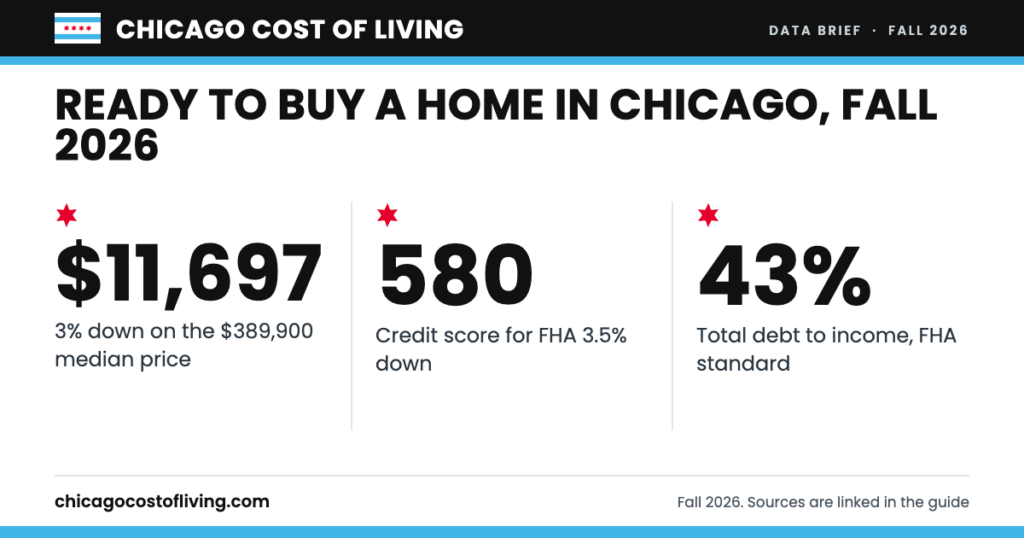
Key takeaway: You are usually financially ready to buy in Chicago when you have a steady two-year income record, total monthly debts at or under about 43% of gross income, a down payment that can be as low as 3% ($11,697 on the $389,900 city median, September 2026) plus cash for closing, and a plan to stay at least five to six years; with 20% down, the median home’s $2,646 monthly payment takes about $102,400 a year in gross income under the 31% housing ratio FHA uses as its standard (our calculation).
This is a checklist for Chicago renters asking whether they are ready to buy. It covers what lenders look at (income, credit, debts, savings), how much you really need for a down payment, and how long you should plan to stay. For the monthly cost of owning compared with renting, see renting vs. buying in Chicago.
This guide is based on two articles by Jason Finn, Vice President of Mortgage Lending at Key Mortgage Services (NMLS #2311805, Chicago Agent, 2026). ChicagoCostOfLiving.com rewrote them and checked every figure against the sources linked in the text. It is not an offer of credit or a lender recommendation.
How do you know you’re ready to buy a home in Chicago?
| Question | Usually a good sign | Details below |
|---|---|---|
| Is your income steady? | About two years of steady, documented pay | Income |
| Is your credit in shape? | 580 or higher for FHA’s 3.5% down; higher scores get better rates | Credit |
| Are your debts in line? | All monthly debts, with the new mortgage, at or under about 43% of gross income | Debt-to-income |
| Do you have the cash? | Down payment, closing costs and an emergency fund left over | Down payment |
| Will you stay? | At least five to six years | How long |
| Are you ready to be the landlord? | Comfortable paying for repairs yourself | Upkeep |
Source: summary of the sections below; each figure is sourced there.
How steady does your income need to be?
Lenders look for income that is stable and likely to continue, and a two-year record is the usual yardstick. For bonus, commission, overtime and tip income, Fannie Mae’s rules recommend at least a two-year history but allow as little as 12 months when other strengths offset the shorter record (Fannie Mae Selling Guide B3-3.3-02, March 2026).
For preapproval, expect to provide at least 30 days of pay stubs, W-2s and tax returns for the past two years, and recent bank statements (Bankrate, June 2025). Gathering them now is the easiest first step.
What credit score do you need to buy a home?
- FHA loans: a score of 580 or higher qualifies for maximum financing (3.5% down). Scores of 500 to 579 are limited to 90% of the value, so 10% down; below 500 is not eligible (HUD FHA answers).
- Conventional loans: Fannie Mae dropped its fixed 620 minimum for loans run through its Desktop Underwriter system on November 16, 2025, and now weighs the whole file instead (HousingWire). Individual lenders can still set their own minimums, and lower scores still pay higher rates.
- Down payment help: IHDA’s programs require 640 and Cook County’s requires 620 (details in our down payment help section).
Pull your free credit reports and fix errors before you apply.
How much debt is too much to buy a house?
Your debt-to-income ratio (DTI) is all your monthly debt payments divided by your gross monthly income, the income before taxes and deductions (CFPB). Limits vary by loan. FHA’s standard is 31% for the housing payment and 43% for all debts, rising to as much as 40% and 50% with two strengths such as cash reserves (HUD Mortgagee Letter 2026-11, October 8, 2026). IHDA’s programs cap it at 50%.
| Worked example: median Chicago home, 20% down | Amount |
|---|---|
| Mortgage principal and interest ($311,920 at 7.18%) | $2,113 a month |
| Property tax ($4,597 a year) | $383 a month |
| Home insurance (estimate) | $150 a month |
| Housing payment | $2,646 a month |
| Gross income for a 31% housing ratio | $8,535 a month, about $102,400 a year |
| Room for other debts under 43% at that income | about $1,024 a month (car, student loans, cards) |
Source: our calculation. Income = $2,646 / 0.31; other debts = $8,535 x 0.43 minus $2,646. Price $389,900 (Illinois Realtors, September 2026), rate 7.18% (Freddie Mac PMMS, November 5, 2026), tax bill $4,597 (Cook County Treasurer, tax year 2025). A condo adds its association fee to the housing payment. To see what a salary covers beyond housing, try our Chicago salary calculator.
Do you really need 20% down to buy in Chicago?
No. Twenty percent avoids mortgage insurance, but several loans start much lower.
| Loan | Minimum down | On the $389,900 median | Worth knowing |
|---|---|---|---|
| Fannie Mae HomeReady (conventional) | 3% | $11,697 | Income limits by area; mortgage insurance can be cancelled later; homebuyer education if all buyers are first-time |
| FHA | 3.5% (score 580 or higher) | $13,647 | Also for two- to four-unit buildings you live in |
| FHA, score 500 to 579 | 10% | $38,990 | Same loan, lower score |
| VA | None, if the price isn’t above the appraised value | $0 | For eligible service members and veterans; no private mortgage insurance |
| Conventional, 20% down | 20% | $77,980 | No mortgage insurance |
Source: Fannie Mae HomeReady; HUD FHA loans and HUD FHA answers; VA purchase loans; all checked November 5, 2026. Dollar amounts are our calculation on the September 2026 median price.
The down payment is not the only cash you need. Chicago buyers also pay the city transfer tax ($3.75 per $500 of the price) and other closing costs, about $14,600 together on the median home in our cash at closing example; every item is in our closing costs guide. Cook County and IHDA programs can cover some of it, and Cook County’s pays up to $25,000. Keep an emergency fund after closing as well, since the first repair bill is yours.
How long should you plan to stay before buying makes sense?
At least five to six years, in most cases. Buying and selling cost a lot up front, and it takes years of paying down the loan and any rise in value to earn that back. With its starting values, our Chicago rent vs buy calculator finds renting ahead by about $3,400 after five years and buying ahead by about $7,700 after six. Life changes that make a longer stay likely (a new job you plan to keep, a growing household) are often the real signal that it’s time.
Are you ready to handle repairs and upkeep?
Owners pay for the furnace, the roof, the plumbing and the appliances. Our rent vs. buy figures budget 1% of the price a year for upkeep, about $325 a month on the median home, and a condo adds its association fee and any special assessments. Rent can rise at every renewal, while principal and interest on a fixed-rate loan stay the same for 30 years, but property tax and insurance still change: the median Chicago homeowner bill rose 3.2% for tax year 2025 (Cook County Treasurer).
What should you do first if you think you’re ready?
- Pull your credit reports and fix any errors.
- Add up your monthly debts and work out your DTI with the formula above.
- Gather pay stubs, two years of W-2s and tax returns, and bank statements.
- Take a homebuyer education course; most down payment programs require one. See getting past the fear of buying in Chicago for free counseling options.
- Get preapproved, then set your budget by what you can comfortably pay, not by the most a lender will approve.
Related: renting vs. buying in Chicago, rent vs buy calculator, closing costs and down payment help, Cook County property tax bill, neighborhood cost comparison.
Figures last checked November 5, 2026. General information for planning, not financial, tax or mortgage advice.