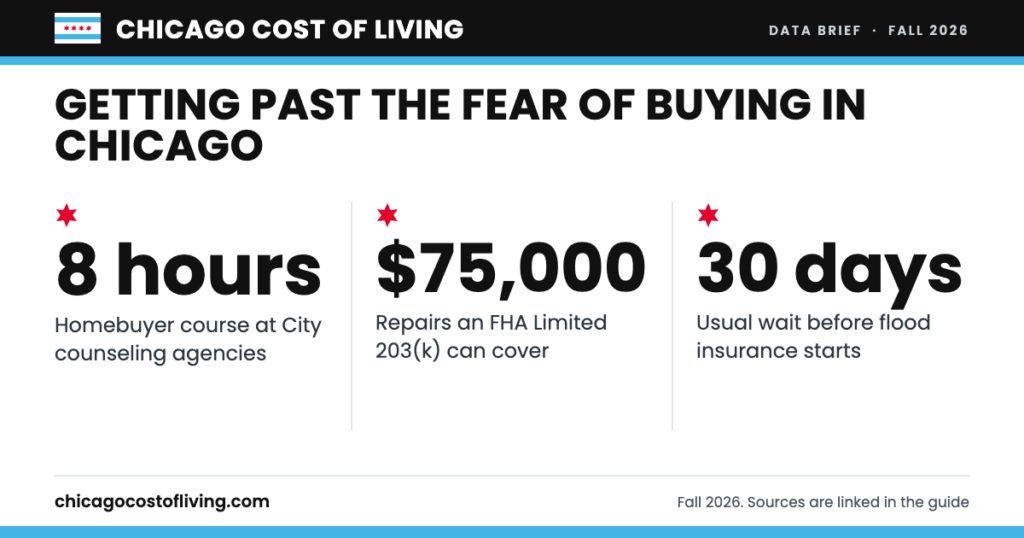
Key takeaway: Most fears about buying a first home in Chicago have a concrete fix: the City lists more than a dozen HUD-approved housing counseling agencies that teach an eight-hour homebuyer course, an FHA Limited 203(k) loan can fold up to $75,000 of repairs into the mortgage, a licensed home inspector checks the house before you commit, and flood insurance, which standard homeowners policies don’t cover, is a separate policy that usually starts 30 days after you buy it.
Buying a first home is one of the biggest money decisions most people make, and feeling nervous about it is normal. This guide is for Chicago renters who want to buy but keep putting it off. It takes the common fears one at a time and points to the free help, loan options and checks that answer each one.
This guide is based on an article by Jason Finn, Vice President of Mortgage Lending at Key Mortgage Services (NMLS #2311805, Chicago Agent, 2026). ChicagoCostOfLiving.com rewrote it and checked every figure against the sources linked in the text. It is not an offer of credit or a lender recommendation.
What are first-time buyers most afraid of, and what helps?
| The worry | What actually helps |
|---|---|
| “I don’t know what I can afford.” | Work out the full monthly cost and your debt-to-income ratio before you shop |
| “I don’t understand the process.” | A free or low-cost homebuyer course and one-on-one counseling |
| “I can’t save 20%.” | Low down payment loans and Cook County and IHDA assistance |
| “The house could have hidden problems.” | A licensed home inspection before you’re committed |
| “Something could go wrong after I move in.” | The right insurance, including flood, and an emergency fund |
| “What if it’s a bad time to buy?” | Plan to stay at least five to six years so short swings matter less |
Source: summary of the sections below; each figure is sourced there.
How do you find out what you can afford before you start looking?
Uncertainty about money drives most of the fear, so start with numbers. Owning Chicago’s median-priced home ($389,900, September 2026) with 20% down costs about $2,971 a month in year one once tax, insurance and upkeep are counted, and needs about $92,600 in cash at closing (our calculation in renting vs. buying in Chicago). Our readiness checklist walks through income, credit, debt-to-income and down payment, and lists the papers a lender will ask for. Having those papers in a folder before you call a lender takes a lot of the stress out of preapproval.
Costs also differ a lot by area. Our Chicago neighborhood cost comparison lists rent and income needed for all 77 community areas, which helps you decide where to look before you fall for a listing.
Where can you get free homebuyer help in Chicago?
HUD-approved housing counselors are independent of any lender or agent. The City of Chicago’s Housing Counseling Centers program lists more than a dozen such agencies across the city, from the Chicago Urban League on South Michigan Avenue to Northwest Center on Diversey and the Chinese American Service League in Chinatown. They offer an eight-hour homebuyer education course, six hours of classes plus two hours of one-on-one counseling. Online certificates are not accepted for most City purchase assistance programs, so take the course in person if you plan to use City help (City of Chicago Department of Housing, updated March 2024).
One example: the Chicago Urban League’s Housing and Financial Empowerment Center is a HUD-approved agency whose pre-purchase workshops and coaching meet the education requirement for several down payment programs, and its services are free to low- and moderate-income Illinois residents (Chicago Urban League). Most assistance programs require a course like this anyway, including Cook County’s for first-time buyers and all of IHDA’s.
What if a standard loan doesn’t fit your situation?
- Small down payment. FHA loans can start at 3.5% down and conventional HomeReady loans at 3%; the full list, with amounts on the median Chicago price, is in our readiness checklist. Cook County’s program adds up to $25,000 and IHDA’s up to $15,000 (details).
- A fixer-upper. FHA’s 203(k) loan combines the purchase and the repairs in one mortgage. The Limited 203(k) covers up to $75,000 in total repair costs, and the work must finish within nine months; bigger jobs use the Standard 203(k), which allows 12 months (HUD, FHA INFO 2024-44, Mortgagee Letter 2024-13).
- A two-flat or three-flat. FHA financing is available on one- to four-unit properties with as little as 3.5% down (HUD), so you can live in one unit and rent the others.
- Credit that isn’t perfect. FHA allows scores down to 500 with 10% down, and Fannie Mae dropped its fixed 620 floor for conventional loans in November 2025; see the credit section of our checklist.
How do you avoid buying a house with hidden problems?
Get a professional home inspection before you’re bound to buy, and make the contract depend on it. Illinois requires home inspectors to hold a license from the Illinois Department of Financial and Professional Regulation (IDFPR), which you can check before you hire one (IDFPR Home Inspection). An inspector looks at the roof, structure, heating, plumbing and electrical systems and can spot problems a buyer would miss. For a condo, also ask the association for its budget, reserve balance and any planned special assessments.
What insurance protects a Chicago home from the unexpected?
Homeowners insurance covers many sudden losses, but homeowners and renters policies do not typically cover flood damage. Flood coverage is a separate policy, and a new National Flood Insurance Program policy generally takes effect 30 days after purchase; buying it as part of a new mortgage is the main exception (FEMA). Ask your agent what the policy covers for water in the basement, and price both policies before closing so they’re part of your monthly budget. Our rent vs. buy examples use $150 a month for homeowners insurance as a starting estimate.
What if it’s a bad time to buy?
No one can call the market. What you control is how long you’ll stay and what you’ll pay. With its starting values, our rent vs buy calculator finds buying pulls ahead of renting between year five and six, so a plan to stay that long gives prices and rates time to even out. If rates fall later, refinancing is an option; if they rise, a fixed-rate loan keeps your principal and interest the same.
Getting past the fear of buying a house: the bottom line
Fear usually comes from not knowing. Run the numbers, take a homebuyer course, line up your papers, inspect before you commit and insure what matters. Each step turns a vague worry into a decision you can make on facts.
Related: are you financially ready to buy?, renting vs. buying in Chicago, closing costs and down payment help, rent vs buy calculator, moving to Chicago cost checklist.
Figures last checked November 5, 2026. General information for planning, not financial, insurance or mortgage advice.