Key takeaway: Chicago’s minimum wage is $17.05 an hour ($12.96 tipped) as of July 1, 2026, about $2,955 a month before taxes for full-time work.
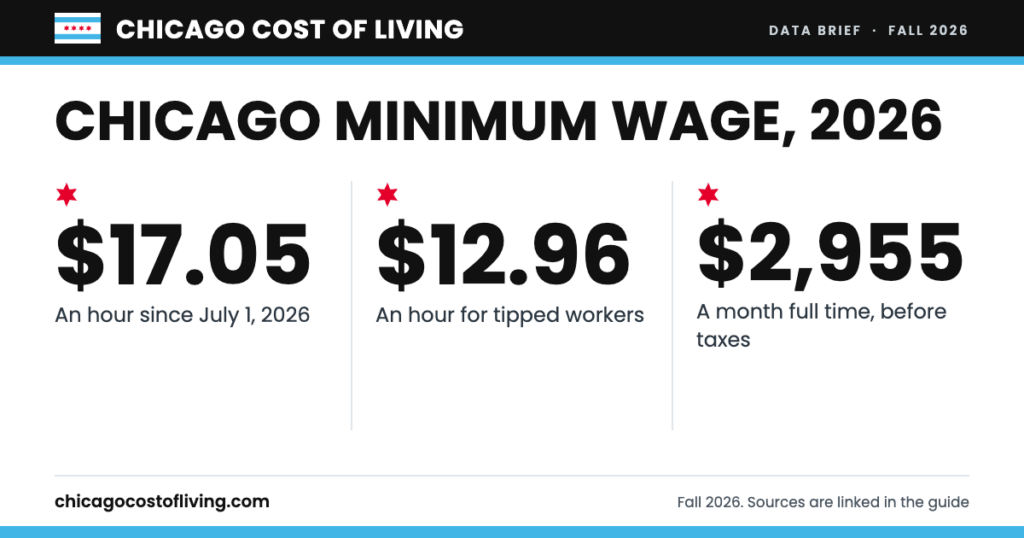
Chicago’s minimum wage rose to $17.05 an hour on July 1, 2026, up from $16.60 (ABC7). Working full time, that’s about $35,464 a year, or roughly $2,955 a month before taxes.
The current Chicago minimum wage
| Where | Standard | Tipped | Since |
|---|---|---|---|
| Chicago, employers with 4+ workers | $17.05 | $12.96 | Jul 1, 2026 |
| Suburban Cook County | $15.40 | $9.25 | Jul 1, 2026 |
| Illinois | $15.00 | $9.00 | Jan 1, 2025 |
Source: ABC7 Chicago, Clockit.
Chicago adjusts its rate every July 1 for inflation. This year’s raise was 45 cents an hour, or about $936 more a year for a full-time worker.
City Council also delayed the phaseout of the tipped wage, so tipped workers won’t see another significant increase until July 2028. Subsidized youth and transitional jobs now pay the full city minimum for the first time (HR Source).
What does the Chicago minimum wage pay per month?
| Item | Per month |
|---|---|
| Full-time pay at $17.05, before taxes | $2,955 |
| Median one-bedroom rent, Sep 2026 | $2,079 |
| CTA 30-day pass | $75 |
| Left for food, utilities, phone and taxes | $801 |
Source: our calculation; rent from Zillow, via Axios, pass price from the CTA fare chart.
Rent alone takes about 70% of gross pay. The common guideline is to keep rent near 30% of income, which at $2,079 means earning about $6,930 a month, or roughly $83,000 a year.
How does the minimum wage compare with a living wage in Chicago?
SmartAsset, using MIT’s Living Wage Calculator, puts the cost of a basic but adequate life for a single adult in the Chicago metro at about $53,664 a year (Fox 32). That’s roughly $25.80 an hour for full-time work, about $8.75 more than the city minimum. Median earnings in the metro are $73,979.
The math gets a lot friendlier with a few choices. Splitting a two-bedroom, picking a neighborhood where rents average closer to $1,500, and riding the CTA instead of owning a car all stretch the same paycheck much further. Our ZIP code rent guide shows where to look, and our guide to how much you need to make to live in Chicago runs the numbers for other budgets.
What $17.05 adds up to at different hours
Many hourly jobs are part time, so here is the same $17.05 rate at 20, 30 and 40 hours a week. Our calculation: weekly pay = $17.05 x hours; yearly pay = weekly pay x 52; monthly pay = yearly pay / 12. All figures are before taxes.
| Hours per week | Weekly pay | Monthly pay | Yearly pay |
|---|---|---|---|
| 20 | $341 | $1,478 | $17,732 |
| 30 | $511.50 | $2,217 | $26,598 |
| 40 | $682 | $2,955 | $35,464 |
Source: our calculation from the $17.05 rate reported by HR Source, checked October 27, 2026.
Payroll taxes before you see your check
Two deductions are the same for every worker. Social Security takes 6.2% and Medicare takes 1.45% of wages, per IRS Publication 15 (2026). Illinois withholds 4.95% of pay after an exemption allowance of $2,925 a year, per the Illinois Department of Revenue 2026 withholding tables.
For a full-time worker earning $35,464, our calculation: Social Security and Medicare = $35,464 x 7.65% = $2,713. Illinois tax = ($35,464 minus $2,925) x 4.95% = $1,611. That leaves $31,140 a year, or about $2,595 a month, before federal income tax. Federal tax depends on filing status and credits, so run your own numbers with our salary calculator.
Paid time off you earn on top of the wage
Chicago’s Paid Leave and Paid Sick Leave Ordinance took effect July 1, 2024. Workers earn 1 hour of paid leave and 1 hour of paid sick leave for every 35 hours worked, and employers must provide at least 40 hours of each, per a Foley law firm summary of the city’s final rules. You are covered once you work at least 80 hours in any 120-day period in Chicago.
- Carryover: up to 16 hours of paid leave and 80 hours of paid sick leave under an accrual policy (Foley).
- Payout when you leave: employers with more than 50 workers must pay out unused paid leave (all of it since January 1, 2025 for those with 51 to 100 workers). Employers with 1 to 50 workers do not have to. Sick leave is never paid out (Jackson Lewis).
- Outside Chicago, the Illinois Paid Leave for All Workers Act gives 1 hour per 40 hours worked, up to 40 hours a year (Illinois Department of Labor).
Those 80 minimum hours are worth $1,364 at $17.05 an hour (our calculation: 80 x $17.05). That is pay you keep on a sick day or a day off instead of losing it.
Related: average salaries by job, the salary calculator and how much it costs to live in Chicago. Also see what a nanny costs in Chicago, with the domestic worker rules.
Sources
- ABC7: Chicago and Cook County minimum wage increases
- HR Source: July 1, 2026 Chicago wage changes
- Clockit: Illinois minimum wage 2026
- Axios: big-city rent comparison
- Fox 32: how far a paycheck goes
- Axios: Chicago rent, Sep 2026
- HR Source: July 1, 2026 Chicago wage and Fair Workweek changes
- IRS: Publication 15 (2026), Employer’s Tax Guide
- Illinois Department of Revenue: 2026 IL-700-T withholding tables
- Foley: Chicago final rules on paid leave and paid sick leave
- Jackson Lewis: Chicago enacts paid leave and paid sick and safe leave ordinance
- Illinois Department of Labor: Paid Leave for All Workers Act