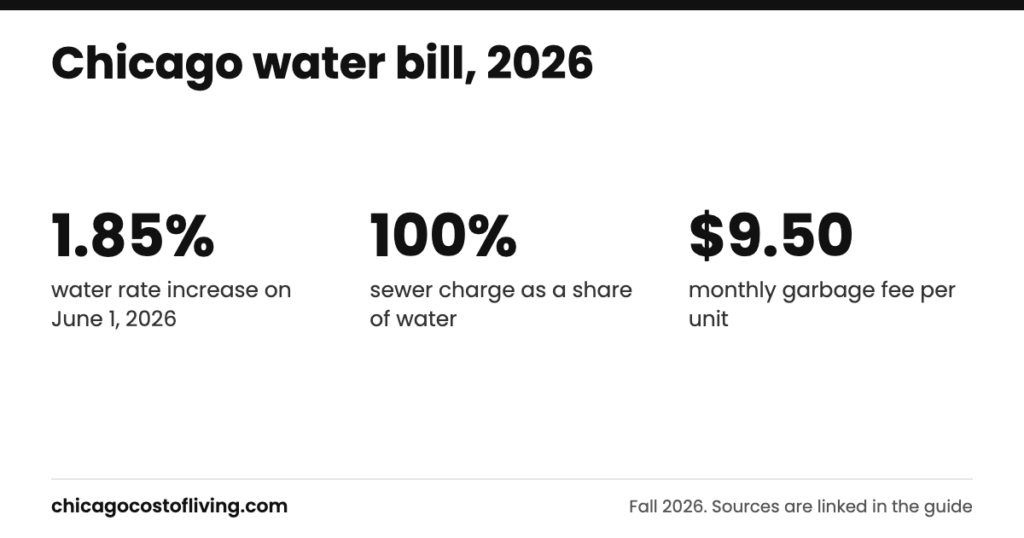
Key takeaway: Chicago homeowners pay for water, sewer, a water-sewer tax and a $9.50 monthly garbage fee per unit on one city bill; water rates rose 1.85% on June 1, 2026, and sewer is billed at 100% of the water charge.
If you rent in a larger building, your landlord usually handles the city utility bill, but if you buy a house, a two-flat or a small building, these charges come to you. Here is how the 2026 bill works and where to find help.
Water and sewer rates
| Effective | Increase | Water rate per 1,000 cubic feet |
|---|---|---|
| June 1, 2024 | 3.37% | $35.10 |
| June 1, 2025 | 4% | $36.51 |
| June 1, 2026 | 1.85% | About $37.19 (our calculation) |
Source: City of Chicago water and sewer rates for 2024; Inside Climate News for 2025; Forest Park Review for the 2026 increase, applied to the 2025 rate by us. The city’s 2024 table puts the cost at about $4.70 per 1,000 gallons. Rates rise each June 1 with the prior year’s Chicago-area inflation, and sewer is charged at 100% of the water charge (City of Chicago).
The water-sewer tax
On top of the rates, the city charges a water-sewer utility tax that phased in from 2017 to 2020. At its 2020 level it is $1.255 per 1,000 gallons on water plus $1.255 on sewer, $2.51 combined, the latest rate the city lists (City of Chicago).
The garbage fee
Homes that get city garbage pickup, meaning single-family houses and buildings with four or fewer units, pay $9.50 per dwelling unit per month: $19 for a two-flat and $38 for a four-unit building. Recycling, yard waste and bulk pickup cost nothing extra (City of Chicago). The 2026 city budget did not raise the fee (WTTW).
A sample monthly Chicago water bill
| Charge | Example: 5,000 gallons a month |
|---|---|
| Water (about $4.97 per 1,000 gallons) | $24.85 |
| Sewer (100% of water) | $24.85 |
| Water-sewer tax ($2.51 per 1,000 gallons) | $12.55 |
| Garbage fee (one unit) | $9.50 |
| Total | About $71.75 |
Source: our calculation from the rates above, using 5,000 gallons a month as an example, not a city average; your bill depends on how much water you use and whether your home has a meter.
Help paying
- Seniors: senior homeowners who live in their home can get the senior sewer exemption, which removes sewer charges and cuts the water-plus-sewer bill in half, and a 50% garbage fee discount, $4.75 a month per unit (City of Chicago; City of Chicago).
- Utility Billing Relief: income-qualified homeowners in a single-family home, two-flat or three-flat get 50% off water, sewer and the water-sewer tax, and past-due balances can be forgiven after a year (City of Chicago). Income generally must be at or below 200% of the federal poverty level (City of Chicago UBR report). Renters are not eligible.
Lead service lines
Chicago still has hundreds of thousands of lead service lines, and replacing one privately can cost $16,000 to $30,000 (ABC7). The city replaces lines for free for income-qualified owner-occupants, after breaks or leaks reported to 311, and during block-long main work; homeowners who replace a line on their own get waived permit fees and a free water meter (Lead Safe Chicago).
If you rent
Under the city’s tenant ordinance, if a landlord fails to pay the water bill, tenants can pay it and deduct the cost from rent (Metropolitan Tenants Organization). For the rest of your monthly bills, see our ComEd and Peoples Gas guide and internet and phone costs.
Sources
- City of Chicago: water and sewer rates
- Inside Climate News: Chicago water rates
- Forest Park Review: 2026 Chicago water increase
- City of Chicago: water-sewer tax FAQ
- City of Chicago: garbage fee FAQ
- WTTW: 2026 Chicago budget
- City of Chicago: Utility Billing Relief
- City of Chicago: UBR annual report
- Lead Safe Chicago: service line replacement
- ABC7: lead pipes in Chicago
- Metropolitan Tenants Organization: utilities