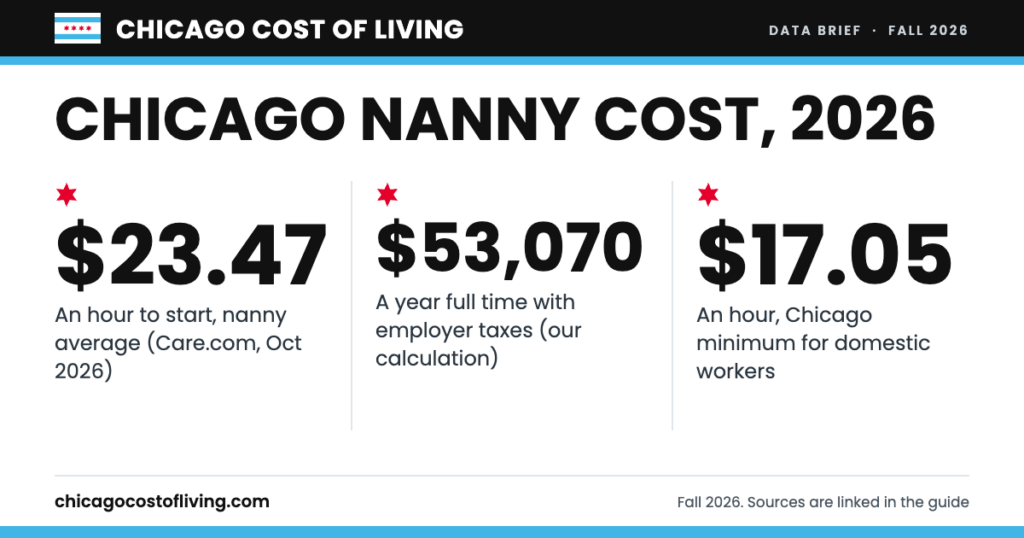
Key takeaway: A nanny in Chicago starts at about $23.47 an hour (Care.com average, October 2026). Full time, 40 hours a week, that is about $48,820 a year in pay plus about $4,250 in employer payroll taxes, or about $53,070 in all (our calculation). Chicago law sets the floor at $17.05 an hour for every domestic worker.
This guide is for Chicago families thinking about hiring a nanny or a regular babysitter. It covers the going hourly rate, the taxes you owe as a household employer, and the city and state rules on pay, time off and days of rest, so you can budget the full cost before you hire. For daycare centers and in-home daycare prices, see our daycare cost guide.
What is the Chicago nanny cost per hour?
In short: the average starting rate for a nanny in Chicago is $23.47 an hour, and the average top rate is $27.76 an hour, based on rates reported by caregivers on Care.com (October 2026).
| Type of care | Average starting rate | Average top rate | Area | Data as of |
|---|---|---|---|---|
| Nanny | $23.47 an hour | $27.76 an hour | City of Chicago | October 2026 |
| Part-time nanny | $22.57 an hour | $27.53 an hour | City of Chicago | July 2026 |
| Babysitter (average posted rate) | $21.01 an hour | Not published | City of Chicago | January 2026 |
| Nanny | $22.10 an hour | $26.90 an hour | Illinois | October 2026 |
| Nanny | $22.29 an hour | $27.45 an hour | United States | October 2026 |
Source: Care.com cost pages for nannies in Chicago, part-time nannies in Chicago and babysitters in Chicago. Rates are reported by caregivers listed on Care.com, not set by any agency.
Care.com turns its Chicago rate into about $3,051 a month, but that assumes 130 hours of work a month. A steady 40-hour week is about 173 hours a month (our calculation: 40 hours times 52 weeks, divided by 12), so a full-time nanny at $23.47 is closer to $4,070 a month before taxes. Rates also differ by site: Nanny Lane reports a lower Chicago average of $18.77 an hour for 2026, and says pay rises with experience, the number of children and evening or weekend hours.
What does a full-time nanny cost per year with taxes?
A full-time Chicago nanny at the average starting rate costs about $53,070 a year with employer taxes, or about $4,420 a month (our calculation). The table shows the math for a full-time and a part-time schedule, paid for all 52 weeks.
| Cost line, per year | Full time: 40 hours a week at $23.47 | Part time: 25 hours a week at $22.57 |
|---|---|---|
| Gross pay (rate times hours times 52 weeks) | $48,817.60 | $29,341.00 |
| Your share of Social Security and Medicare (7.65% of pay) | $3,734.55 | $2,244.59 |
| Federal unemployment tax (0.6% of the first $7,000) | $42.00 | $42.00 |
| Illinois unemployment insurance (3.35% of the first $14,250) | $477.38 | $477.38 |
| Total employer taxes | $4,253.93 | $2,763.97 |
| Total yearly cost | $53,071.53 | $32,104.97 |
| About per month | $4,423 | $2,675 |
Source: our calculation. Hourly rates from Care.com (October 2026 and July 2026). Tax rates for 2026 from IRS Publication 926 (2026) and the Illinois Department of Employment Security 2026 contribution rates (3.35% is the entry rate for new employers). Formula: yearly pay = hourly rate x hours a week x 52; employer taxes = pay x 7.65% + $42 federal unemployment + 3.35% of pay up to $14,250.
What the table leaves out: overtime, raises, bonuses, a health or transit stipend, mileage, backup care while your nanny is on paid leave, and payroll service fees. Your nanny’s own 7.65% for Social Security and Medicare is withheld from their pay, so it is not an extra cost to you unless you choose to pay it for them, which the IRS allows. At the city minimum of $17.05 an hour, a 40-hour week comes to $35,464 in pay and about $38,696 a year with employer taxes (our calculation, same formula).
When do you owe nanny taxes in Chicago?
A nanny who works in your home is your household employee, and the tax rules turn on how much you pay in cash wages. These are the 2026 thresholds:
- Social Security and Medicare: owed once you pay one household employee $3,000 or more in cash wages in 2026. You pay 6.2% plus 1.45% (7.65%) and withhold the same from the employee. The Social Security part stops at $184,500 of wages. (IRS Publication 926)
- Federal unemployment (FUTA): owed if you pay $1,000 or more in total cash wages to household employees in any calendar quarter of 2025 or 2026. The rate is 6.0% of the first $7,000 per employee, cut to 0.6% ($42) with the full credit for state unemployment tax paid on time. (IRS Publication 926)
- Illinois unemployment insurance: owed once you pay $1,000 in cash wages in one calendar quarter for domestic work (IDES). In 2026 it applies to the first $14,250 of each worker’s pay, at 3.35% for most new employers (IDES 2026 rates).
- Income tax withholding: not required. You withhold federal income tax only if your nanny asks and you agree, using a Form W-4. (IRS Publication 926)
- Teen sitters: pay to a worker under 18 whose main job is not household work, such as a student, generally does not count for Social Security and Medicare. (IRS Publication 926)
- Paperwork: you need an employer identification number (EIN). For 2026 wages, give your nanny a Form W-2 and file it with the Social Security Administration by February 1, 2027, and report the taxes on Schedule H with your federal return by April 15, 2027. (IRS Publication 926)
Even a regular sitter can cross all three thresholds. Ten hours a week at Care.com’s $21.01 average comes to about $10,925 a year, or about $2,730 a quarter (our calculation), which is over the $3,000 yearly and $1,000 quarterly lines.
What do Chicago and Illinois require you to give a nanny?
- Minimum wage of $17.05 an hour since July 1, 2026 (Fox 32, June 8, 2026). Chicago’s minimum wage usually covers employers with four or more workers, but domestic workers get it no matter how few people you employ (City of Chicago Office of Labor Standards FAQ). See our Chicago minimum wage guide.
- Overtime at time and a half for hours over 40 in a week (Illinois Department of Labor). State rules adopted in 2022 confirm domestic workers such as nannies are covered by the Illinois Minimum Wage Law (IDOL, August 1, 2022).
- Paid leave and paid sick leave: after working at least 80 hours in a 120-day period for you, a Chicago domestic worker earns 1 hour for every 35 hours worked, up to 40 hours of each type in a 12-month period (City of Chicago, For Domestic Workers).
- A day of rest: if your nanny works at least 20 hours a week for you, you cannot require 7 days in a row (City of Chicago). Under state law a domestic worker gets at least 24 hours in a row off in every 7 days, and if they agree to work that day, those hours are paid at the overtime rate (Public Act 102-0828).
- A written contract in your nanny’s preferred language, required in Chicago since January 1, 2022, whether they are an employee or an independent contractor (City of Chicago).
- Room and board: you can deduct the cost of housing or food from pay only if what is left still meets the Chicago minimum wage (City of Chicago).
Is a nanny cheaper than daycare in Chicago?
For one child, a center usually costs less. Full-time infant care at a quality Chicago center runs about $1,800 to $2,900 a month (Wonderschool, 2026, in our daycare cost guide), while a full-time nanny at the average starting rate is about $4,420 a month with employer taxes (our calculation above). With two young children, two center spots come to about $3,600 to $5,800 a month (our calculation, the same range times two), which is where a nanny starts to compare. Paying a nanny on the books also lets you use the dependent care tax breaks, such as a dependent care FSA and the child and dependent care credit; see the federal tax breaks section of our daycare cost guide.
Numbers on this page last checked October 29, 2026 against the sources below.
Related: What daycare costs in Chicago, Cost of raising a kid in Chicago, Chicago minimum wage in 2026 and How much you need to make to live in Chicago.
Sources
- Care.com: How much does a nanny cost in Chicago, IL (October 2026)
- Care.com: Part-time nanny cost in Chicago, IL (July 2026)
- Care.com: Babysitters in Chicago, IL (average rate, January 2026)
- Nanny Lane: Nanny cost in Chicago, IL (2026)
- IRS: Publication 926 (2026), Household Employer’s Tax Guide
- Illinois Department of Employment Security: Taxes and reporting
- IDES: 2026 State Experience Factor and Employers’ UI Contribution Rates (EA-50)
- City of Chicago: For Domestic Workers
- City of Chicago Office of Labor Standards: Minimum Wage FAQs
- Fox 32: Chicago’s minimum wage will increase in July (June 8, 2026)
- Illinois Department of Labor: Worker rights
- Illinois Department of Labor: Domestic worker rules finalized (August 1, 2022)
- Illinois Public Act 102-0828 (One Day Rest In Seven Act changes)