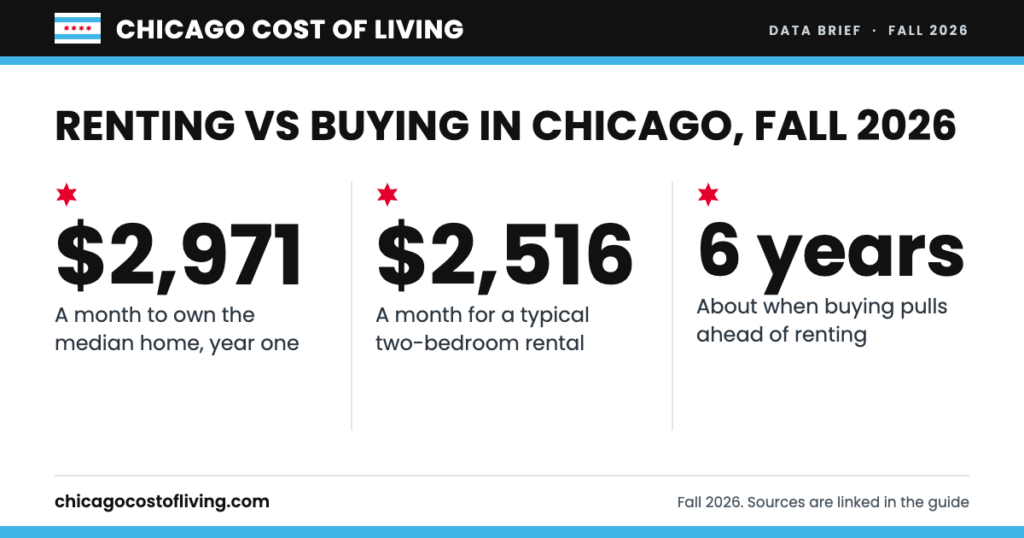
Key takeaway: Owning a median-priced Chicago home ($389,900, September 2026) with 20% down at the November 5, 2026 mortgage rate of 7.18% costs about $2,971 a month in year one, compared with $2,516 for a typical two-bedroom rental, and buying usually pulls ahead of renting only after about five to six years (our calculation).
This guide is for Chicago renters weighing a first purchase. It lays out what each choice costs each month and up front, which owner costs build equity and which don’t, what down payment help exists right now, and when buying starts to win. To run your own numbers, use our Chicago rent vs buy calculator.
This guide is based on an article by Jason Finn, Vice President of Mortgage Lending at Key Mortgage Services (NMLS #2311805, Chicago Agent, 2026). ChicagoCostOfLiving.com rewrote it and checked every figure against the sources linked in the text. It is not an offer of credit or a lender recommendation.
What do renting and buying cost in Chicago right now?
| Figure | Amount | What it measures and where | Source and date |
|---|---|---|---|
| Median sale price | $389,900 | All home types sold, City of Chicago | Illinois Realtors, September 2026 |
| Typical two-bedroom rent | $2,516 a month | City of Chicago | Rentometer, May 2026, via our Chicago rent guide |
| Typical one-bedroom rent | $2,079 a month | City of Chicago | Zillow, August 2026, via our Chicago rent guide |
| Mortgage rate | 7.18% a year | 30-year fixed, national average | Freddie Mac PMMS, week of November 5, 2026 |
| Property tax bill | $4,597 a year | Median homeowner bill, City of Chicago | Cook County Treasurer, tax year 2025 bills, mailed 2026 |
Source: each row names its source and date. The sale price and the rents describe different groups of homes, so they are a starting point, not a like-for-like match. For a real decision, compare a specific home with the rent on a similar unit nearby. Rents by area are in our Chicago neighborhood cost comparison.
What does owning a median-priced Chicago home cost each month?
The mortgage payment is only part of it. Here is year one for the $389,900 median home with 20% down ($77,980) and a $311,920 30-year loan at 7.18%, next to renting a typical two-bedroom.
| Monthly cost, year one | Own | Rent |
|---|---|---|
| Mortgage principal and interest | $2,113 | |
| Property tax ($4,597 a year) | $383 | |
| Home insurance (estimate) | $150 | |
| Upkeep (1% of the price a year) | $325 | |
| Rent, typical two-bedroom | $2,516 | |
| Renters insurance | $17 | |
| Total | $2,971 | $2,533 |
Source: our calculation. Payment = loan x r / (1 minus (1 + r) to the power of minus 360), with r = 7.18% / 12. Insurance and upkeep are the same estimates our rent vs buy calculator starts with; renters insurance is from our renters insurance guide. A condo adds its monthly association fee on top: most Chicago condos pay $250 to $800 a month (AskDoss, updated September 2026).
How much of an owner’s payment builds equity?
Less than most people expect in the early years. In year one on the loan above, the payments add up to about $25,357, and only about $3,060 of that pays down the loan (about $255 a month). The other $22,296 is interest (our calculation from the same loan). Property tax, insurance, condo fees and repairs build no equity at all. Rent builds none either, but it also carries no repair bills, so the fair comparison is total cost against total cost.
Rent adds up too. At $2,516 a month with no increases, it comes to $30,192 a year, $90,576 over three years and $150,960 over five (our calculation, $2,516 x months). Rents usually rise at renewal, so treat those as floor figures.
How much cash do you need to buy in Chicago?
| Cash at closing, $389,900 home | Amount |
|---|---|
| Down payment, 20% | $77,980 |
| Chicago transfer tax paid by the buyer, $3.75 per $500 | $2,924 |
| Other closing costs, about 3% (lender, title, inspection, prepaid items) | $11,697 |
| Total | about $92,600 |
Source: our calculation. Transfer tax rate from the City of Chicago Department of Revenue; the 3% for other closing costs is the estimate in our rent vs buy calculator. Every line item is broken out in our guide to closing costs and condo fees when you buy in Chicago. A smaller down payment lowers the cash needed but usually adds mortgage insurance and raises the monthly cost. Renting needs far less up front: deposits, move-in fees and movers are covered in our Chicago move-in costs guide.
What are the advantages of buying in Chicago?
- Equity over time. Each payment shifts a little more toward principal, and any rise in the home’s value adds to it. Values can also fall; appreciation isn’t guaranteed.
- A fixed core payment. With a fixed-rate loan, principal and interest stay at $2,113 a month for 30 years. Property tax, insurance and condo fees still change: the median Chicago homeowner bill rose 3.2% for tax year 2025 (Cook County Treasurer).
- Control of the space. Owners can renovate, within condo association rules, zoning and building codes.
- Long stays pay off. The one-time costs of buying and selling get spread over more years, which is why the break-even point below is measured in years.
What are the advantages of renting in Chicago?
- Much less cash up front. The roughly $92,600 above can stay in savings or investments.
- Easy to move. Selling a home typically costs about 6% in agent and other costs, plus 0.45% in seller transfer taxes in Chicago (city, county and state), as set out in our closing costs guide. A renter can move when the lease ends.
- No big repair bills. The furnace, roof and plumbing are the landlord’s job, subject to the lease and the law.
- Room to invest the difference. Money not tied up in a down payment can earn a return. Our calculator assumes 4% a year by default; change it to see how much it matters.
When does buying beat renting in Chicago?
With its starting values (median price, 20% down, a 7.24% rate, 3% yearly growth in home value and rent), our rent vs buy calculator finds renting ahead by about $3,400 after five years and buying ahead by about $7,700 after six. So if you might move within two or three years, renting usually costs less. If you expect to stay ten years or more, buying usually comes out ahead. Neither result is guaranteed: a cheaper condo with a high association fee, slower price growth or a higher rate can push the break-even point out by years. The calculator lets you change each of these.
What down payment help can Chicago buyers get?
Cook County Down Payment Assistance Program. Reopened July 20, 2026. It pays 5% of the first mortgage amount, up to $25,000, toward the down payment, closing costs or a rate buydown, as a second loan forgiven over five years. Households up to 120% of area median income qualify ($145,800 for a family of four), with no income limit in Disproportionately Impacted Areas or Qualified Census Tracts. Repeat buyers can use it; first-time buyers must finish a HUD-approved counseling course before closing, and the minimum credit score is 620 (Cook County, July 2026). On the $311,920 loan above, 5% is $15,596 (our calculation).
IHDA (Illinois Housing Development Authority). IHDA lists five options, each paired with its 30-year fixed mortgage: a deferred loan of 6% up to $15,000 for first-time buyers (Access Home, launched March 2026), Opening Doors at a flat $9,000 forgiven over five years, a forgivable loan of 4% up to $6,000 forgiven over ten years, a deferred loan of 5% up to $7,500, and a repayable 10% loan up to $10,000. All require homebuyer education, a 640 credit score and a debt-to-income ratio of 50% or less. Deferred loans are repaid when you sell or refinance (IHDA Mortgage, checked November 5, 2026).
The City of Chicago’s HomeGrown program and how the programs combine are covered in What down payment help can Chicago buyers get? in our closing costs guide. Federal options include FHA-insured loans through HUD and VA home loans for eligible service members and veterans. Funding and limits change often, so confirm with the program before you count on it.
Do Chicago homeowners get a tax break?
Often a smaller one than people expect. Mortgage interest and property tax only lower your federal tax if you itemize, and the 2026 standard deduction is $16,100 for single filers and $32,200 for married couples filing jointly (Journal of Accountancy, October 2025). On the median home above, year-one interest ($22,296) plus the property tax bill ($4,597) is about $26,900 (our calculation). That beats the single standard deduction but not the married one, before counting other deductions such as state income tax and gifts to charity. Illinois has a flat 4.95% income tax and Chicago has no city income tax; see our Chicago salary calculator.
Owners who live in the home can also claim the Cook County Homeowner Exemption, which takes $10,000 off the home’s equalized assessed value (Cook County Assessor). The $4,597 median bill already reflects exemptions. How the bill is built is in your Cook County property tax bill, explained.
What should you check before you decide?
- How long you’ll stay. This matters more than any other single input. Run two or three stay lengths in the calculator.
- What you can comfortably pay, not what a lender approves. A preapproval shows how much you can borrow; your budget decides how much you should. Our guide to how much it costs to live in Chicago shows the rest of a monthly budget.
- An emergency fund after closing. Owners pay for the broken water heater themselves.
- For a condo, the association’s finances. Ask for the budget, the reserve balance and any planned special assessments before you sign.
- Free advice. HUD-approved housing counselors review budgets, credit and loan offers; find one through HUD.
Commute and transit count too. Living near an L or Metra line can mean skipping a car, which costs far more than a transit pass in Chicago; compare what it costs to own a car in Chicago with CTA fares.
Renting vs buying in Chicago: the bottom line
Neither choice is always cheaper. In fall 2026, owning the median Chicago home costs about $440 a month more than renting a typical two-bedroom in year one and needs about $92,600 in cash, but it starts building equity and usually comes out ahead after about six years. Renting keeps your cash free and your options open. The right answer depends on your budget, your savings and how long you plan to stay.
Related: Chicago rent vs buy calculator, are you financially ready to buy?, getting past the fear of buying, closing costs and condo fees, Cook County property tax bill, Chicago one-bedroom rent, neighborhood cost comparison.
Figures last checked November 5, 2026. General information for planning, not financial, tax or mortgage advice.