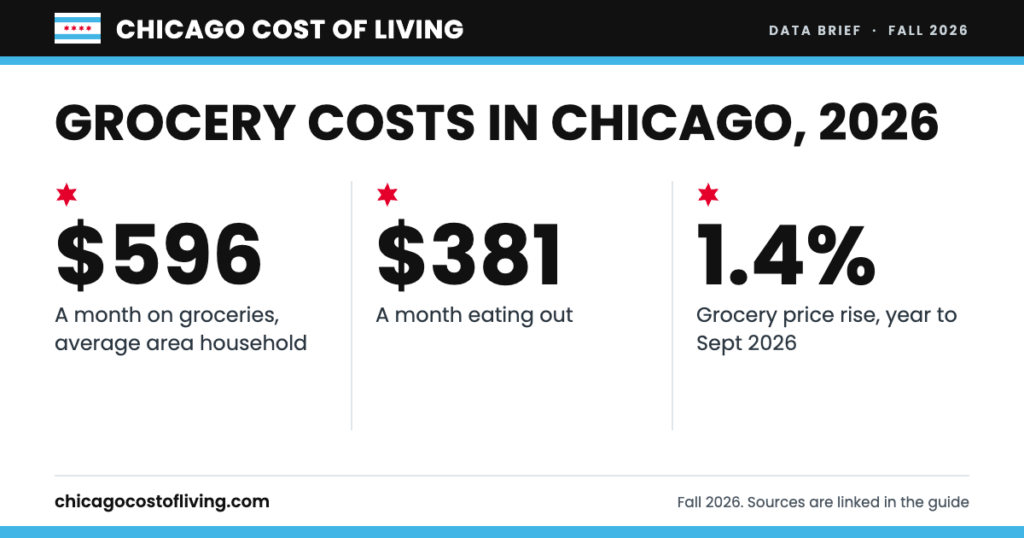
Key takeaway: Grocery prices in the Chicago area rose just 1.4% over the year to September 2026, and the average Chicago-area household spends about $596 a month on groceries and $381 eating out.
Good news for your grocery budget: food at home is rising more slowly than most other costs here. And where you shop matters more than almost anything else, with store prices varying by a third or more.
How fast grocery costs in Chicago are rising
| Category | 12-month change, Chicago area |
|---|---|
| Food at home (groceries) | +1.4% |
| Food away from home (restaurants) | +4.1% |
| All items | +2.9% |
| Energy | +15.1% |
Source: Bureau of Labor Statistics, Consumer Price Index for Chicago-Naperville-Elgin, September 2026, released October 14, 2026.
What Chicago households spend on food
| Measure | Per year | Per month |
|---|---|---|
| Groceries (food at home) | $7,148 | about $596 |
| Eating out | $4,567 | about $381 |
Source: Bureau of Labor Statistics, Consumer Expenditures in the Chicago area, 2023 to 2024, released January 21, 2026. The average household has 2.4 people; monthly figures are our calculation.
A grocery budget by eating style
| USDA food plan | Adult woman, per month | Adult man, per month |
|---|---|---|
| Thrifty | $253.90 | $319.00 |
| Low-cost | $276.30 | $317.70 |
| Moderate | $336.40 | $398.40 |
| Liberal | $429.60 | $486.80 |
Source: USDA Cost of Food reports, September 2026 national averages (thrifty plan; low-cost, moderate and liberal plans). Ages 19 or 20 to 50, priced for a four-person household; USDA suggests adding about 10% for a two-person household and 20% for one person living alone. The thrifty plan comes from a separate USDA report, which is why it isn’t always the lowest number.
Where you shop matters
Chicago-area Checkbook, a nonprofit consumer group, compared prices at area grocery chains against the all-store average in its most recent survey (updated November 2025).
| Store | Prices vs. area average |
|---|---|
| ALDI | about 33% lower |
| Amazon Fresh | about 13% lower |
| Walmart | about 12% lower |
| Food 4 Less | about 9% lower |
| Meijer | about 9% lower |
| Mariano’s | about 8% higher |
| Fresh Thyme | about 16% higher |
| Whole Foods | about 29% higher |
Source: Chicago-area Checkbook supermarket survey. Prices change, so treat these as a guide to which stores tend to cost less, not exact savings.
Ways to spend less
- Split your list: staples at a discount store, specialty items wherever you like.
- Bring your own bags to skip the 15 cent bag tax.
- Cook more nights: restaurant prices are rising almost three times as fast as grocery prices here.
- Check store apps for weekly digital deals before you go.
What staples cost
| Item | Average price, September 2026 |
|---|---|
| Ground beef, per pound (Midwest) | $6.75 |
| Eggs, per dozen (U.S.) | $2.27, down from $3.49 a year earlier |
| Whole milk, per gallon (U.S.) | $4.11 |
| White bread, per pound (U.S.) | $1.83 |
Source: BLS average retail food prices. BLS did not publish September 2026 Midwest prices for eggs, milk or bread, so those rows use the national average.
Stretch SNAP dollars with Link Match
If you use a LINK card, Link Match gives you a free dollar of fruits and vegetables for every SNAP dollar you spend on produce at participating farmers markets and stores, including some Cermak, Jewel-Osco and Tony’s locations. Grocery stores cap the match at $5, $10 or $25 a day depending on the store (Link Up Illinois).
What groceries cost for a family of four
The USDA prices its food plans for a reference family of two adults and two children ages 6 to 8 and 9 to 11. Here is what that family’s groceries cost in September 2026, at U.S. average prices.
| USDA food plan | Per week | Per month |
|---|---|---|
| Thrifty | $236.30 | $1,024.00 |
| Low-cost | $260.10 | $1,126.90 |
| Moderate | $320.50 | $1,389.20 |
| Liberal | $388.00 | $1,681.80 |
Source: USDA Cost of Food reports for September 2026, thrifty plan and low-cost, moderate and liberal plans, checked October 27, 2026. The thrifty total is printed in the report. The other three are our calculation: the plan’s costs for a man 19 to 50, a woman 19 to 50, a child 6 to 8 and a child 9 to 11, added together. For example, low-cost per month is $317.70 + $276.30 + $261.50 + $271.40 = $1,126.90.
USDA does not publish a Chicago version, so treat these as a starting point. For comparison, the average Chicago-area household of 2.4 people spends about $596 a month on groceries, per the BLS figure above.
SNAP (Link card) amounts from October 1, 2026
In Illinois, SNAP benefits are paid on the Link card. These are the maximum monthly benefits for October 1, 2026 through September 30, 2027.
| Household size | Maximum per month |
|---|---|
| 1 | $306 |
| 2 | $562 |
| 3 | $808 |
| 4 | $1,023 |
| 5 | $1,217 |
| 6 | $1,463 |
| 7 | $1,616 |
| 8 | $1,841 |
Source: USDA Food and Nutrition Service, SNAP cost-of-living adjustments for fiscal year 2027, checked October 27, 2026.
Each person past eight adds $225. The minimum benefit for one- and two-person households is $25 a month. The family-of-four maximum sits close to the thrifty plan above because USDA uses that same reference family “to determine the maximum Supplemental Nutrition Assistance Program (SNAP) allotment” (USDA).
Is there a grocery tax in Chicago in 2026?
Not from the state or the city. Illinois ended its 1% sales tax on groceries on January 1, 2026, and let cities and counties replace it with a local 1% tax by ordinance (Illinois Department of Revenue). Chicago has not. A city grocery tax ordinance was introduced on June 18, 2025, and is now listed as stale (Chicago Councilmatic). Chicago is also not on the state’s list of places starting a local grocery tax on July 1, 2026 (Illinois Department of Revenue). WTTW estimated the change saves most families $115 a year.
One tax still applies. The regional transit tax, now collected for the Northern Illinois Transit Authority, covers qualifying groceries. In Cook County it rose to 1.50% on August 1, 2026 (Illinois Department of Revenue). On a $596 monthly grocery bill, that is about $8.94 a month (our calculation: $596 x 0.015).
Related: Chicago restaurant, hotel and streaming taxes, Chicago minimum wage and our full guide to how much it costs to live in Chicago. Also see the Chicago cost of living FAQ.
Sources
- BLS: Consumer Price Index, Chicago area
- BLS: Consumer Expenditures in the Chicago area
- USDA: Cost of Food reports
- Chicago-area Checkbook: supermarket prices
- BLS: average retail food prices
- Link Up Illinois: Link Match
- USDA: Cost of Food at Home, Thrifty Food Plan, September 2026
- USDA: Cost of Food at Home, Low-Cost, Moderate-Cost and Liberal Food Plans, September 2026
- USDA Food and Nutrition Service: SNAP cost-of-living adjustments
- Illinois Department of Revenue: FY 2026-11, Municipal and County Grocery Occupation Tax Rate Changes, Effective January 1, 2026
- Illinois Department of Revenue: FY 2026-25, Municipal and County Grocery Occupation Tax Rate Changes, Effective July 1, 2026
- Illinois Department of Revenue: FY 2026-34, NITA Occupation and Use Tax Rate Change, Effective August 1, 2026
- Chicago Councilmatic: Ordinance O2025-0018151
- WTTW: Chicago’s 2026 budget takes effect